Search

The V Word

Advocating to end sexual and domestic violence

Tag

stalking

Ways to Support Stalking Awareness in Your Community #2 – send in an Op-Ed

Write a letter to your local paper’s Op-Ed section on your views about stalking and it’s relation to both sexual assault and domestic violence and what you would like your community to do.

Need ideas to promote and facts?  Check out www.stalkingawarenessmonth.org for fact sheets

Ways to Support Stalking Awareness in your community #3 – Tweet about it!

31 Days of Status Updates

Each day in January you can help raise awareness about stalking. Just use one of the suggested messages
for your social networking site status update, your tweet, or your Instant Message (IM) away message. If
you’re tweeting, add #NSAM to the end of the tweet!  Stalking Awareness Month.org has a sheet of suggestions for you.  Just copy and post!

January 1, 2013 – January is National Stalking Awareness Month. Visit stalkingawarenessmonth.org for more info.
January 2, 2013 – Stalking is a course of conduct directed at a specific person that would cause a reasonable person to feel fear.
January 3, 2013 – What are you doing to recognize National Stalking Awareness Month? Visit stalkingawarenessmonth.org for more info.
January 4, 2013 – Stalking is a crime that is pervasive, dangerous, and potentially lethal. Visit stalkingawarenessmonth.org for more info.
January 5, 2013 – 6.6 million people are stalked each year in the United States. Visit stalkingawarenessmonth.org for more info.
January 6, 2013 – What would you say to a friend who told you they were being stalked? Visit stalkingawarenessmonth.org for more info.
January 7, 2013 – It’s not a joke. It’s not romantic. It’s not ok. Stop stalking. It’s a crime. Visit stalkingawarenessmonth.org for more info.
January 8, 2013 – Although women are more likely to be stalked than men, anyone can be a victim of stalking. Visit http://bit.ly/srcncvc for more info.
January 9, 2013 – 1 in 4 women and 1 in 13 men will be victims of stalking in their lifetime. Visit http://bit.ly/srcncvc for more info.
January 10, 2013 – Stalking is a crime. Do you know what your state stalking law says? Visit stalkingawarenessmonth.org for more info.

January 11, 2013 – Would you report it if you were being stalked? Most victims don’t. Visit stalkingawarenessmonth.org for more info.
January 12, 2013 – Stalking is often treated as a joke or “not that big of a deal.” Why do you think that is? Visit http://bit.ly/srcncvc for more info.
January 13, 2013 – What services are available for stalking victims in your community? Visit stalkingawarenessmonth.org for more info.
January 14, 2013 – Intimate partner stalking is the most common type of stalking and the most dangerous. Visit stalkingawarenessmonth.org for more info.

January 15, 2013 – Try this: Google “track girlfriend” and see how many sites tell someone how to stalk. Visit stalkingawarenessmonth.org for more info.

January 16, 2013 – Phones, computers, GPS, and cameras are some of  the common forms of technology used by stalkers.

January 17, 2013 – What messages about stalking are in the media? Tweet us what you see. For examples: http://bit.ly/SCLtVn

January 18, 2013 – Rates of stalking among college students are higher than the general public. Visit stalkingawarenessmonth.org for more info.

January 19, 2013 – How young can stalking behavior start? Do you see stalking behaviors among high school students? Middle school students? Younger?

January 20, 2013 – Most stalking victims know their stalker. Visit stalkingawarenessmonth.org for more info.

January 21, 2013 – “Injustice anywhere is a threat to justice everywhere” – Rev. Dr. Martin Luther King, Jr.

January 22, 2013 – Stalkers often reoffend; recidivism rates are as high as 60%. Visit stalkingawarenessmonth.org for more info.                                                                       

January 23, 2013 – Behaviors that may seem benign to you or me may be terrorizing to a stalking victim. Visit stalkingawarenessmonth.org for more info.

January 24, 2013 – Stalking can affect a victim’s emotional, physical, and economic well-being. Visit stalkingawarenessmonth.org for more info.

January 25, 2013 – Most alarmingly, stalking also can be lethal. Visit stalkingawarenessmonth.org for more info.    

January 26, 2013 – Stalkers often access information about victims that is available online. Do you know what information about you is online?                                              

January 27, 2013 – Victims of stalking are encouraged to keep a log of all stalking behaviors including emails, texts & phone messages.                                                         

January 28, 2013 – It is important to consider how to victims may be harmed by stalkers’ use of technology. Visit http://bit.ly/srcncvc for more info.                          

January 29, 2013 – The majority of stalking victims report losing time from work as well as income because of the stalking.                                                                                 

January 30, 2013 – Stalking: Know it. Name it. Stop it. Visit stalkingawarenessmonth.org for more info.                                                                                                                             

January 31, 2013 – How will you continue your efforts to raise awareness about stalking throughout the year? Visit http://bit.ly/srcncvc for more info.

Stalking: Know It, Name It, Stop It

January is National Stalking Awareness Month, a time to focus on a crime that affects 6.6 million victims a year.

While legal definitions of stalking vary from one jurisdiction to another, a good working definition of stalking is a course of conduct directed at a specific person that would cause a reasonable person to feel fear.

STALKING VICTIMIZATION

• 6.6 million people are stalked in one year in the United States.
• 1 in 6 women and 1 in 19 men have experienced stalking victimization at some point during their lifetime in which they felt very fearful or believed that they or someone close to them would be harmed or killed. Using a less conservative definition of stalking, which considers any amount of fear (i.e., a little fearful, somewhat fearful, or very fearful), 1 in 4 women and 1 in 13 men reported being a victim of stalking in their lifetime.
• The majority of stalking victims are stalked by someone they know. 66% of female victims and 41% of male victims of stalking are stalked by a current or former intimate partner.
• More than half of female victims and more than 1/3 of male victims of stalking indicated that they were stalked before the age of 25.
• About 1 in 5 female victims and 1 in 14 male victims experienced stalking between the ages of 11 and 17. [Michele C. Black et al., “The National Intimate Partner and Sexual Violence Survey: 2010 Summary Report,” (Atlanta, GA: National Center for Injury Prevention and Control, Centers for Disease Control and Prevention, 2011).]
• 46% of stalking victims experience at least one unwanted contact per week.
• 11% of stalking victims have been stalked for 5 years or more. [Katrina Baum et al., “Stalking Victimization in the United States,” (Washington, DC: Bureau of Justice Statistics, 2009).]

STALKING AND INTIMATE PARTNER FEMICIDE

• 76% of intimate partner femicide victims have been stalked by their intimate partner.
• 67% had been physically abused by their intimate partner.
• 89% of femicide victims who had been physically assaulted had also been stalked in the 12 months before their murder.
• 79% of abused femicide victims reported being stalked during the same period that they were abused.
• 54% of femicide victims reported stalking to police before they were killed by their stalkers.
[Judith McFarlane et al., “Stalking and Intimate Partner Femicide,” Homicide Studies 3, no. 4 (1999).]

RECON STUDY OF STALKERS

• 2/3 of stalkers pursue their victims at least once per week, many daily, using more than one method.
• 78% of stalkers use more than one means of approach.
• Weapons are used to harm or threaten victims in 1 out of 5 cases.
• Almost 1/3 of stalkers have stalked before.
• Intimate partner stalkers frequently approach their targets, and their behaviors escalate quickly. [Kris Mohandie et al.,“The RECON Typology of Stalking: Reliability and Validity Based upon a Large Sample of North American Stalkers,” Journal of Forensic Sciences, 51, no. 1 (2006).]

IMPACT OF STALKING ON VICTIMS

• 46% of stalking victims fear not knowing what will happen next.
• 29% of stalking victims fear the stalking will never stop.
• 1 in 8 employed stalking victims lose time from work as a result of their victimization and more than half lose 5 days of work or more.
• 1 in 7 stalking victims move as a result of their victimization. [Baum et al.]
• The prevalence of anxiety, insomnia, social dysfunction, and severe depression is much higher among stalking victims than the general population, especially if the stalking involves being followed or having one’s property destroyed. [Eric Blauuw et al., “The Toll of Stalking,” Journal of Interpersonal Violence, 17, no. 1 (2002):50-63.]

STALKING LAWS

• Stalking is a crime under the laws of 50 states, the District of Columbia, the U.S. Territories, and the Federal government.
• Less than 1/3 of states classify stalking as a felony upon first offense.
• More than 1/2 of states classify stalking as a felony upon second or subsequent offense or when the crime involves aggravating factors.
• Aggravating factors may include: possession of a deadly weapon, violation of a court order or condition of probation/parole, victim under 16 years, or same victim as prior occasions.
For a compilation of state, tribal, and federal laws visit www.victimsofcrime.org/src.

__________________________________________________________________________________________________________________________________

The mission of the Stalking Resource Center is to enhance the ability of professionals, organizations, and systems to effectively respond to stalking. The Stalking Resource Center envisions a future in which the criminal justice system and its many allied community partners will effectively collaborate and respond to stalking, improve victim safety and well-being, and hold offenders accountable. Visit us online at www.victimsofcrime.org/src. Contact us at 202-467-8700 or src@ncvc.org.
This document was developed under grant number 2008-TA-AX-K017 from the Office on Violence Against Women (OVW) of the U.S. Department of Justice. The opinions and views expressed in this document are those of the author(s) and do not necessarily represent the official position of the Office on Violence Against Women of the U.S. Department of Justice. For more information on the U.S. Department of Justice Office on Violence Against Women visit http://www.ovw.usdoj.gov

This document may be reproduced only in its entirety. Any alterations must be approved by the Stalking Resource Center

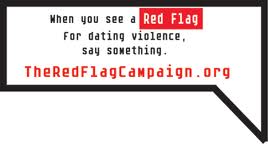
Red Flag Campaign

It’s that time of year again, October and the Red Flag Campaign Awareness Events are happening at Universities and Colleges around the state. The Virginia Sexual and Domestic Violence Action Alliance are collaborating with identified schools to bring awareness to dating violence, sexual assualt, and other interpersonal violence in recognition of Domestic Violence Awareness Month.

The Red Flag Campaign is a public awareness campaign designed to address dating violence and promote the prevention of dating violence on college campuses. The campaign was created using a “bystander intervention” strategy, encouraging friends and other campus community members to “say something” when they see warning signs (“red flags”) for dating violence in a friend’s relationship. The campaign posters reflect racially and ethnically diverse models, and illustrate both heterosexual and same-sex relationships.

The Campaign is a project of the Virginia Sexual and Domestic Violence Action Alliance, and was created by college students, college personnel, and community victim advocates. The Campaign is funded by grants from the Verizon Foundation, Verizon Wireless, Macy’s Foundation, and the Centers for Disease Control and Prevention.

Research indicates that in 21% of college dating relationships, one of the partners is being abused. That’s 1 in 5 relationships (see citation below). Whether you are a student seeking help for yourself or a friend, or a professional seeking information about how you can help students, we hope the materials on this website will be helpful to you.

Check out the new series of Red Flag Campaign posters.

C. Sellers and M. Bromley, “Violent Behavior in College Student Dating Relationships,” Journal of Contemporary Criminal Justice (1996)

reposted from http://www.theredflagcampaign.org/

Seeking individuals for a series of portraits

I am seeking to do portraits of individuals who are survivors of sexual and interpersonal violence. I want to collect stories of surviving, healing, and thriving. If you would like to be a subject, contact me at olson.carolann@gmail.com.

Send me your story, photos of you if you are comfortable with that, stories of your healing and where you are now. I plan to exhibit or show what I create once completed in some form.

I look forward to the stories..

The National Intimate Partner and Sexual Violence Survey

The National Intimate Partner and Sexual Violence Survey (NISVS) has published it’s survey on sexual violence and intimate partner violence.   The continuing incidents yearly, monthly, daily, and every minute may shock you.  They found that on average: 

24 people per minute are victims of rape, physical violence, or stalking by an intimate partner in the United States.

Annually that equals more than 12 million women and men.

More than 1 million women are raped in a year and over 6 million women and men are victims of stalking in a year.

These findings emphasize that sexual violence, stalking, and intimate partner violence are important and widespread public health problems in the United States.  This would be considered an epidemic if a disease. 

 NISVS is an on¬going, nationally representative survey that assesses experiences of sexual violence, stalking, and intimate partner violence among adult women and men in the United States. It measures lifetime victimization for these types of violence as well as victimization in the 12 months prior to the survey. The survey goes beyond counting acts of sexual violence, stalking, and intimate partner violence by assessing the range of violence experienced by victims and the impact of that victimization. The report also includes the first ever simultaneous national and state-level prevalence estimates of these forms of violence for all states.

 Findings from the 2010 Summary Report will be available online

 http://www.cdc.gov/violenceprevention/nisvs/index.html

Stalking: Know it, Name it, Stop it

January is National Stalking Awareness Month, a time to focus on a crime that affects

3.4 million victims a year.

1 This year’s theme—“Stalking: Know It. Name It. Stop It.”—challenges the nation to fight this dangerous crime by learning more about it.

Stalking is a crime in all 50 states and the District of Columbia, yet many victims and criminal justice professionals underestimate its seriousness and impact. In one of five cases, stalkers use weapons to harm or threaten victims,

2 and stalking is one of the significant risk factors for femicide (homicide of women) in abusive relationships.

3 Victims suffer anxiety, social dysfunction, and severe depression at much higher rates than the general population, and many lose time from work or have to move as a result of their victimization.

4Stalking is difficult to recognize, investigate, and prosecute. Unlike other crimes, stalking is not a single, easily identifiable crime but a series of acts, a course of conduct directed at a specific person that would cause that person fear. Stalking may take many forms, such as assaults, threats, vandalism, burglary, or animal abuse, as well as unwanted cards, calls, gifts, or visits. One in four victims reports that the stalker uses technology, such as computers, global positioning system devices, or hidden cameras, to track the victim’s daily activities.

5 Stalkers fit no standard psychological profile, and many stalkers follow their victims from one jurisdiction to another, making it difficult for authorities to investigate and prosecute their crimes.

Communities that understand stalking, however, can support victims and combat the crime.

If more people learn to recognize stalking, we have a better chance to protect victims and prevent tragedies.

Your local rape crisis or domestic violence center can offer information, resources, or help.

For additional resources to help promote National Stalking Awareness Month, please visit http://stalkingawarenessmonth.org  and www.ovw.usdoj.gov 

1 Baum et al.,

Stalking Victimization in the United States

, Washington, DC: U.S. Department of Justice, Office of Justice Programs,

Bureau of Justice Statistics, 2009, http://www.ojp.usdoj.gov/bjs/pub/pdf/svus.pdf (accessed September 29, 2009).

2 Ibid.

3 Jacquelyn C. Campbell et al., “Risk Factors for Femicide in Abusive Relationships: Results from a Multi-site Case Control Study,”

American Journal of Public Health

93 (2003): 7.

4 Ibid.

5 Baum,

Stalking Victimization in the United States.

New Protective Orders in Virginia

Starting July 1, 2011, Virginia has made some changes to its Protective Order Laws (HB 2063/SB 1222).  These changes were made to simplify the protective order process in Virginia; provide equal access to Protective Orders for victims of sexual assault, stalking, and dating violence; and to provide equal protections through court/law enforcement response to violations of protective orders for victims of sexual assault, stalking, and dating violence.   These changes are:

Changes to Family Abuse Protective Orders: The definition of Family Abuse has now been revised to specifically include stalking and sexual assault within the definition.  There have also been changes in the relief provisions.  The new definition of Family Abuse is:  “any act involving violence, force, or threat that results in bodily injury or places one in reasonable apprehension of death, sexual assault or bodily injury and that is committed by a person against such person’s family or household member.  Such act includes, but is not limited to, any forceful detention, stalking, criminal sexual assault in violation of Article 7 (& 18.2-61 et seq.) of Chapter 4 of Title 18.2, or any criminal offense that results in bodily injury or places one in reasonable apprehension of death, sexual assault or bodily injury. 

Changes in Family Abuse EPO, PPO, PO-Relief Provisions:  prohibits acts of family abuse “or criminal offenses that result in injury to person or property.”  Additionally, prohibits such contacts “by the respondent with the petitioner or family or household members of the petitioner” as the court deems “necessary for the health and safety of such persons.”

Changes to Acts of Violence Protective Orders: acts of violence or “behaviors” will be same as that of the new definition of family abuse, added the elimination of warrant requirement, applies the Law Enforcement Response for violations: “Pro-Arrest” provisions, and the 34rd or subsequent violation = Class 6 Felony.

There are new definitions of Acts of Violence, Force or Threat: that states, “Acts of violence, force or threat” means any act involving violence, force, or threat that results in bodily injury or places one in reasonable apprehension of death, sexual assault, or bodily injury.  Such act includes, but is not limited to, any forceful detention, stalking, criminal sexual assault in violation of Article 7 (&18.2-61 et seq.) of Chapter 4 of Title 18.2, or any criminal offense that results in bodily injury or places one in reasonable apprehension of death, sexual assault or bodily injury.

Changes to Acts of Violence – Eligibility: deletion of references to specific acts, such as sexual battery, aggravated sexual batter, serious bodily injury, and stalking and replaced with references to “act of violence, force or threat” and the removal of warrant requirement.

Changes to Acts of Violence: EPO – Grounds.  Here Law Enforcement or the Victim asserts that there has been an *Act of violence, force or threat and on that assertion, the magistrate finds that there is probably danger of a further such act being committed by the Perpetrator against the alleged victim or a petition or warrant for the arrest of the Perpetrator has been issued for any criminal offense resulting form the commission of an act of violence, force, or threat. 

Changes to Acts of Violence: PPO-Grounds.  Here a petition alleging the petitioner is or has been subjected to an act of violence, force or threat or a petition or warrant for the arrest of the Perpetrator has been issued for any criminal offense resulting from the commission of an act of violence, force, or threat and may be issued ex parte upon good cause shown.  The immediate and present danger of any act of violence, force or threat or evidence sufficient to establish probably cause that an act of violence, force, or threat has recently occurred shall constitute good cause. 

Changes to Acts of Violence: PO-Grounds. Here, a petition, warrant or conviction for any criminal offense resulting from the commission of an act of violence, force or threat has been established and a hearing held pursuant to subsection D of &19.2-152.9 (PPO Statute). 

Acts of Violence EPO, PPOs, PO – Relief Provisions: prohibits acts of violence, force or threat or criminal offenses resulting in injury to persons or property; prohibit such contacts by the Perpetrator with the alleged victims or such victim’s family/household members as the judge/magistrate deems necessary to protect the safety of such persons and such other conditions as the judge/magistrate deems necessary to prevent (i) acts of violence, force or threat, (ii) criminal offense resulting in injury to person or property or (iii) communication or contact of any kind by the Perpetrator. 

Court/Law Enforcement Response to Violations of Acts of Violence Protective Orders: makes consistent misdemeanor and felony penalties for violations of Family Abuse Pos and violations of non-Family Abuse Pos.; pro-arrest measure of violations of Pos or &18.2-57.2 will be added to violations of Acts of Violence PO; Law enforcement may request an extension of an Acts of Violence EPO, not to exceed 3 days, for a victim who I physically or mentally incapable of filing a petition for a preliminary or permanent protective order.

This is a lot to take in!  So to Recap:  These changes creates one standard for getting protections for victims of family abuse and for victims of other acts of violence, including sexual assault, stalking, and dating violence.  It removes the criminal warrant requirement for the protective order issued by the General District Court, and adds enhanced penalties for violation of the protective order issued by the General District Court so that the penalties are the same as those for violating the Family Abuse Protective Order.  Additionally, it requires law enforcement to make an arrest for violation of a protective order issued by the General District Court (Pro-Arrest provision). 

If you need further information, please call the Virginia Sexual and Domestic Violence Action Alliance at 804-377-0335 and ask to speak to Gena Boyle.

Stalking is a Crime in Virginia

Stalking is a crime.

In Virginia, stalking is defined as repeated conduct which places a person, or his or her family, in reasonable fear of death, sexual assault, or bodily injury.

The stalking law went into effect on July 1, 1992.

In 1998, the penalties associated with convictions were increased. A first conviction carries a penalty of not more than one year in jail and a $2,500 fine (Class 1 misdemeanor).  The penalty for a third or subsequent conviction within five years is not more than five years in prisonand a $2,500 fine (Class 6 felony).

Stalking is a unique crime, because stalkers are obsessed with controlling their victims’ actions and feelings. Stalkers will frequently threaten and harass, and in many instances will actually physically injure their victims. Stalking is a crime that can be committed against anyone, regardless of gender, race, sexual orientation, socioeconomic status, or geographic location.

Facts:

• 1.4 million people are stalked annually.

• Only one half of stalking cases are reported to authorities, and 25% receive a restraining order.•

1 in 20 women will be stalked in their lifetimes.

• 79% of women know their stalkers; 50% were in anintimate relationship with their stalker; 80% of theserelationships were abusive.

*Statistics supplied by the National Institute of Justice

CODE OF VIRGINIA18.2 – 60.3

STALKING PENALTY

A. Any person who on more than one occasion engages in conduct directed at another person with the intent to place, or with the knowledge that the conduct places, that other person in reasonable fear of death, criminal sexual assault, or bodily injury to that other person or to that other person’s family or household member shall be guilty of a Class 1 misdemeanor.

B. A third or subsequent conviction occurring within five years of a conviction for an offense under this section or for a similar offense under the law of any otherjurisdiction shall be a Class 6 felony.

C. A person may be convicted under this section irrespective of the jurisdiction or jurisdictions within the Commonwealth wherein the conduct described in subsection A occurred, if the person engaged in that conduct on at least one occasion in the jurisdiction where the person is tried. Evidence of any such conduct which occurred outside the Commonwealth may be admissible, if relevant, in any prosecution under thissection provided that the prosecution is based upon conduct occurring within the Commonwealth.

The Code of Virginia also provides that:

•Upon conviction for stalking, the court must issue an order prohibiting contact between the defendant and the victim or the victim’s family or household member. (18.2-60.3D)

• The Department of Corrections, sheriff or regional jail director must notify, prior to release of an inmate, any victim of the offense who, in writing, requests notice,or any person designated in writing by the victim, provided the inmate was sentenced to a term of incarceration of at least forty-eight hours. The responsibleagency above must also give notice, if an inmate escapes. (18.2-60.3E)

• Persons subject to protective orders may not purchase or transport any firearms. (18.2-308.1:4)

Create a free website or blog at WordPress.com.

Up ↑